February 21, 2026
As They Are
The Parent’s Tao Te Ching, by William Martin
When you are with your children
be one with them.
Let every part of your body relax
and become as supple as your child’s
Allow all expectations and anxieties to melt away
so that you can see clearly
Love them as they are
In this very moment,
without needing to change a thing
When their lives are filled with trouble
allow events to unfold
without pushing or straining,
and you will understand clearly
what your role should be.
You nourish them without possessing them
You guide them without controlling them
You help them without worrying
Dear Friends,
Happy Lunar New Year! Recently, Tricycle magazine invited me to write a short reflection on what I am practicing. As a divorced mother of a teenage son, working full-time and teaching meditation on weekends, I have very little time for formal sitting. My mantra is “small moments, many times.” Some days I find fifteen quiet minutes on the cushion or lying on the bed. Most days, I find brief moments of awareness scattered throughout the day.
As the lunar year brings in Fire Horse energy, it feels as if every bucket I juggle—parenting, work, teaching, learning—fills to a different level. In the past year, I’ve learned to leave empty space in my calendar, allowing room for rest, reflection, and serendipity. I have intentionally not scheduled any teachings for the second half of 2026. I’ve also canceled programs in the first half of the year that no longer feel aligned.
My son has entered high school. He is a competitive chess player and is learning to find his way as a teenager in this age, balancing so many priorities himself. Lately I’ve been asking myself: What does it mean to be a supportive mother? Where is the right balance between trust and guidance, space and accountability? When does the desire to control disguise itself as love and support? When does love become spoiling? What does unconditional love look like in action? Most importantly, can my son feel it—in his heart and bones?
In many Asian cultures, control is often wrapped in the language of love. We say, “I’m doing this for your own good,” or “This is for your future.” In the process, children’s wills and voices can be quietly crushed. In cultures shaped by filial piety and reverence for elders, asserting one’s own voice can be seen as disrespectful and ungrateful.
Recently, I watched a Chinese drama called “Go Ahead”—a rather unfortunate English title. The original Chinese title translates more directly as “In the Name of Family.” The show explores different kinds of parents and their impact on their children. All of the parents love with good intentions. Yet some leave deep trauma, while others offer stability and healing.
I watched it twice because it moved me so deeply. The father who offered the greatest sense of love and safety was the owner of a small neighborhood noodle shop—an ordinary, kind-hearted single widower who loved children. He raised his own daughter, adopted a son, and helped raise another from a neighboring family. Though not related by blood, these children grew up with a deep bond due to their father’s love.
His love was quiet. He cooked the food his children liked. He listened deeply. He made sure they knew he would never abandon them. He respected their choices, even if they were not his wishes, and may require him to make sacrifices. He worried, but did not burden them with his emotions. He shared his wisdom gently, often beginning with, “I don’t have much education and don’t know much…” When they made mistakes, he named the wrongdoing without shaming their character. When they weren’t ready to speak about their pain, he did not press. He simply let them know he noticed—and that he was there. His love was like a low stream, always flowing. Quiet, steady, life-giving. A Tao Te Ching-style of parenting, a yin way of parenting. In the process, he healed them of the wounds inflicted by their original family.
Throughout my life, my own parents were unconditionally supportive. They trusted my choices—from choosing an art high school and a women’s college, to marrying a Jewish husband and converting to Judaism, to later divorcing and becoming Buddhist. They drew the line only at one choice: when I tried to become a vegetarian, once as a teen and later as a middle-aged woman. (Divorce, okay. Eating only vegetables, no!)
Yet somehow with that upbringing, I find it challenging to give my son the same spaciousness. Parenting has become my deepest practice. In family relationships—where attachment runs deep and interpersonal patterns are strong—our unhealed wounds surface unconsciously and unexpectedly. Multicultural influences and modernity send us mixed messages about the role of a parent. In these tangled knots and messy moments, I can clearly see where my practice has taken root and where I am still caught. If we can train our mind to be like a still lake, reflecting without judgment, we can see our patterns and wounds, and there lie the seeds of freedom and tremendous potential for healing and breaking patterns. Practicing through relationship is hard—yet deeply transformative.
Beyond parenting, I am also practicing these questions: What is alive for me? What brings joy and peace in the midst of so much collective suffering?
This is not about turning away from suffering. It is about finding the sources of strength and hope that allow us to keep believing in the possibility of a better world. When I pay attention, I see ordinary people doing extraordinary things—acts of compassion, courage, and solidarity.
Recently, I was deeply moved by the Walk for Peace: nineteen monks walked on foot from Texas to Washington, D.C.—a journey of 2,300 miles, and the warm reception they received in every community large and small. This, too, exists—kind, compassionate people longing for peace and welcoming a group of Asian Buddhist monks everywhere in America. It gave me hope that, beyond social media images and rhetoric, more people in this country recognize our shared humanity than it appears.
In my life right now, sharing meditation practices is my small way of contributing to a more compassionate world.
On March 13-15, I’ll support my dear friend Sebene Selassie in her workshop, Mindfulness of the Elements for True Connection, at Kripalu. Sebene has deeply influenced the way I think about the world, my practice, and my life. She constantly inspires me to think deeper in my choices. Come hang out with Sebene and learn from her how to connect the elements!
In April, I’ll collaborate with my friend Felicia Dickerson on a pilgrimage walk through Lower Manhattan, visiting the African Burial Ground National Monument, the National Museum of the American Indian, and the 9/11 Memorial, reflecting together on American history and what it means to each of us. In May, I’ll offer an evening on Buddhist wisdom in classical Chinese poetry—a lifelong love that I could not imagine having an opportunity to share before. As I embrace my roots, it seems like my life has become more integrated.
After a long, frigid winter in the Northeast, I can feel spring energy stirring.
May this season bring green shoots, renewal, and the quiet courage to be kind in our ordinary lives in these extraordinary times.
Blessings,
Lin
What nourished my spirit this past month:
- Walk for Peace: “Peace is not an idea we admire from afar, but a path we choose with our own steps.”
- Karia Jewel Lingo: Love letter to an ICE Agent
- Yo-Yo Ma: “Our Common Nature” podcast series
- Chloe Zhao: The Director of ‘Hamnet’ on the Oscars and Her Midlife Crisis | The Interview
- William Martin: The Parent’s Tao Te Ching: Ancient Advice for Modern Parents
- TV drama: “Go Ahead”
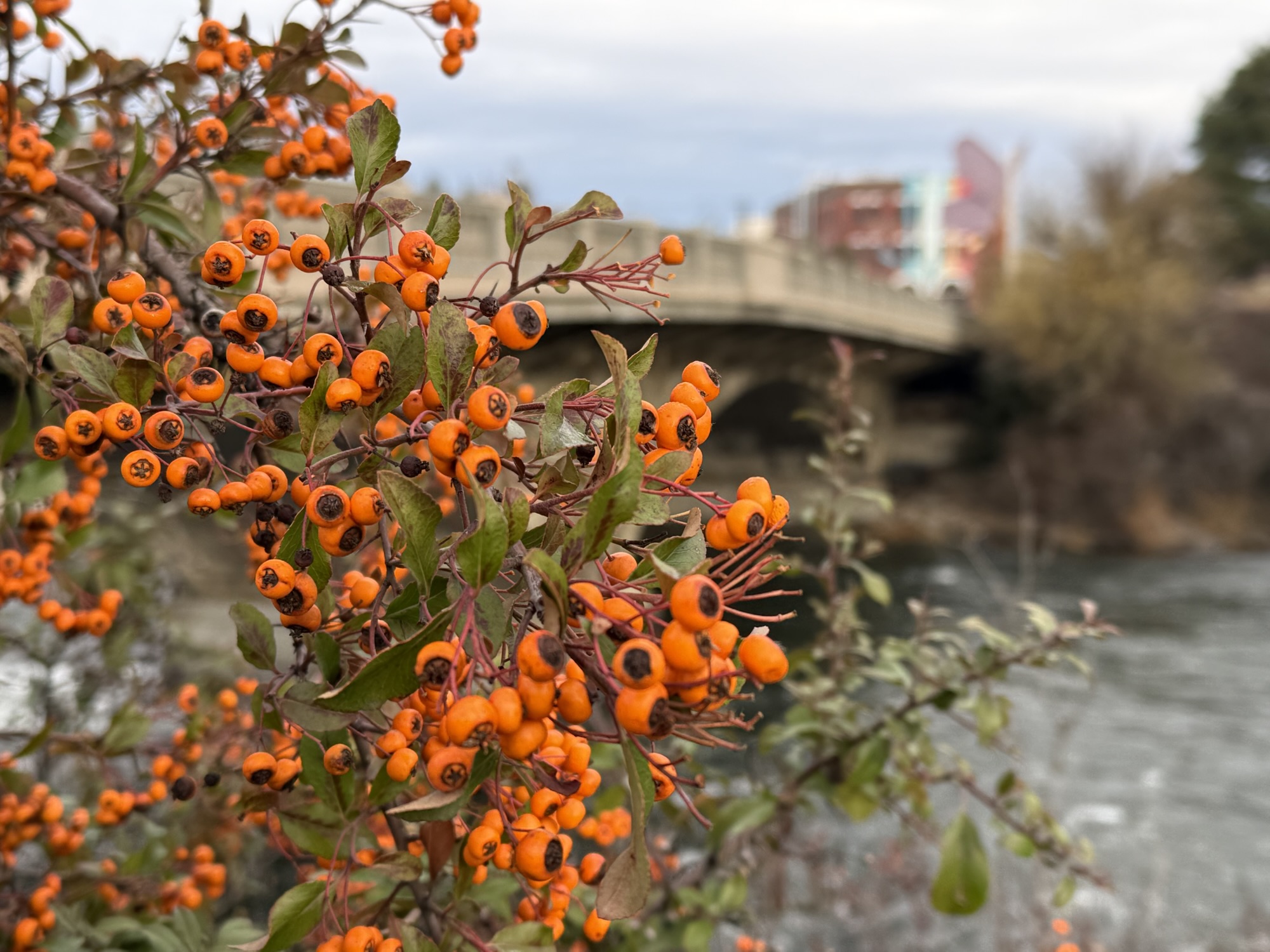
Photo: Scarlet firethorn by the roadside, Spokane, Washington, December 2025
GoFundMe: 2025 -2027 Spirit Rock’s Community Dharma Leadership Training
Pay it forward: I’ll be joining the next Community Dharma Leadership (CDL7) training at Spirit Rock Meditation Center. This program includes five retreats over two years and costs ~$14,000. Your contribution will help me cover these expenses. No contribution is too small—every donation is deeply appreciated. Thank you for your support!