May 17, 2026
At seven times seven [age 49] a woman’s heavenly dew wanes;
The Yellow Emperor’s Classic of Internal Medicine, an excerpt from the first chapter of a Chinese classical medicine book written around 2600 BC (some say 300 BC)
the pulse of her Conception channel decreases.
The Qi that dwelt in the baby’s palace moves upward into her heart,
and her wisdom is deepened.
Dear Friends,
Happy almost summer! How have you been?
I just realized I haven’t written in three months — and what three months it has been.
Lately, I’ve been experiencing perimenopausal symptoms: irregular and prolonged cycles that led to anemia, along with dizziness and fatigue. Once I started talking openly about what I was experiencing with friends and family, I discovered how common this is for women my age — and yet, somehow, no one really talks about it.
It feels like a best-kept secret.
It reminded me of becoming a new mother. Everyone tells you that you may not get enough sleep, but no one tells you that you might not sleep continuously every night for an entire year. Then, when I spoke about it, other parents nodded knowingly with sympathetic smiles, as if to say, “Yes, we all went through this too.”
It’s a rite of passage, a natural phase of life, yet you have to stumble upon it to discover it as if this is the first time human kind has done this and learning to manage through it, and then later found out that everyone before you had struggled through this. We celebrate the joys of motherhood, but often neglect to speak honestly about the physical, emotional, and spiritual challenges that accompany this transformational phase.
Likewise, perimenopause and menopause are natural phases of life, just as aging is natural for all living things. What feels unnatural is how invisible this experience remains despite affecting half the population. When there is little awareness or conversation, there is also few remedies and little support.
Perimenopause and menopause remain under-researched and underserved areas of medicine. Historically, women’s health research focused primarily on reproduction and childbirth, leaving midlife hormonal transitions largely overlooked. Perimenopause wasn’t recognized as a distinct medical term until the 1960s, and only in the last decade has research begun to explore how fluctuating hormones affect the brain and body.
There are also significant gaps in physician education. Many general practitioners — and even OB/GYNs — receive limited training in perimenopause and menopause. Only about 20% to 31% of OB/GYN residency programs offer any dedicated curriculum or formal clinical training in menopause and perimenopause. As a result, symptoms like fatigue, brain fog, anxiety, and insomnia are often treated separately rather than understood holistically as stemming from hormonal transition.
Yet women have been experiencing hormonal changes in midlife since the dawn of time. Many traditional societies have traditional remedies for this.
As modern society has become increasingly secular, many of the rituals that once helped guide people through life’s rites of passage have faded away. Historically, many cultures held reverence for the menstrual cycle — from its beginning to its end. Today, most women are never initiated into an understanding of menstruation as something sacred or deeply connected to their identity and life force. It is perhaps no surprise that we also lack meaningful ceremonies and education around the completion of that cycle.
In the modern West, menopause is often heavily medicalized and associated with decline, loss of youth, or diminished value. Rather than recognizing it as a powerful transformation, our culture tends to pathologize it.
But what if this stage of life is not simply about loss, but a redirection? A rebirth?
What if it’s a unique transformational time for a woman to embrace her vitality and claim her power, when her creative energy is redirected from birthing and bringing up children to channeling her energy into creativity and deepening and imparting her wisdom to the next generation?
Studies suggest that mindset matters: viewing this transition as natural, temporary, and meaningful can help reduce stress, which itself influences symptom severity. The stories we tell ourselves about aging matter.
Traditional cultures often viewed menopause not as a condition to “fix,” but as an initiation into a new and respected stage of life — one associated with freedom, wisdom, spiritual authority, and elderhood.
In Chinese culture, Traditional Chinese Medicine (TCM) views perimenopause as a natural life transition into the “Second Spring”. It is seen as a normal time of adjustment when the body shifts its energy and balances Qi, Blood, Yin, and Yang. Practitioners focus on rebalancing the body and restoring vitality. In this view, according to TCM practitioner Cassandra Young, “When our body ceases menstruation, the qi and blood are redirected to our heart, where our ‘Shen’ or Spirit resides. It is this shift in qi and blood that allows us to access the vibrancy, courage and creativity that accompany our Second Spring.”
Just hearing this reframed my entire understanding of what I am experiencing. It conveys a sense of vitality and rebirth rather than simply loss and aging. And perhaps this should not surprise us. In nature, aging and dying are never separate from renewal. Nature is cyclical, not linear.
We can honor these rites of passage with rituals and with a deeper meaning of our lives.
During this time, I have found practicing the “Five Daily Remembrances” meditation grounding. The phrases are:
1. I am of the nature to grow old; there is no way to escape growing old.
2. I am of the nature to have ill health; there is no way to escape having ill health.
3. I am of the nature to die; there is no way to escape death.
4. All that is dear to me and everyone I love are of the nature to change. There is no way to escape being separated from them.
5. My actions are my only true belongings. I cannot escape the consequences of my actions. My actions are the ground upon which I stand.
It reminds me that aging, sickness, and death are part of the natural cycle of life. It also reminds me of the preciousness of the time I have — with my family, my loved ones, and this fleeting life itself. This leads to the last remembrance: “My actions are my only true belongings.”
How do I want to spend this precious time? What actions do I want to take? What truly matters?
Rather than creating fear, these reflections encourage me to live more honestly, love more deeply, and make choices that bring a little more freedom and happiness into the world.
Yesterday, I attended a calligraphy exhibition by a Japanese woman who is 103 years old. She demonstrated calligraphy live for her students and admirers. At 103, her mind was sharp, her brushstrokes were filled with spirit, and her presence radiated vitality.
She embodied something beautiful: aging not as diminishment, but as deepening.
By sharing this, I hope it encourages you — and the people in your life — to speak openly about this life stage and journey. Perhaps together we can help create a culture that honors aging rather than pathologizing it.
May you journey well into the summer and blossom.
Blessings,
Lin
What nourished my spirit in the past few months:
- A Sacred Approach to Perimenopause
- Why Women in Other Cultures Experience Perimenopause Differently, And What We Can Learn
- Menopause the ‘Second Spring’
- Ease into Perimenopause With These 3 Tips
- The Seven Year Cycles of Women’s Development: A TCM Theory
- Honoring the Menopause Journey: 14 Empowering Rituals
- Buddhism’s “Five Remembrances” Are Wake-Up Calls for Us All
- India Is Building The Electric Economy Without The Fossil Detour
- Rainforests Can Bounce Back Much Faster Than Thought, Researchers Say
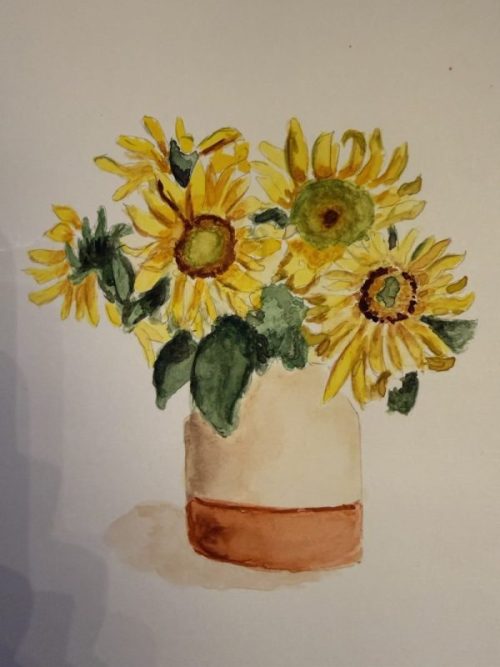
Photos: Watercolor doodling while waiting for my son’s long chess tournament days – such joy to pick up watercolor again for the first time since high school, March 2026.
GoFundMe: 2025 -2027 Spirit Rock’s Community Dharma Leadership Training
Pay it forward: I’ll be joining the next Community Dharma Leadership (CDL7) training at Spirit Rock Meditation Center. This program includes five retreats over two years and costs ~$14,000. Your contribution will help me cover these expenses. No contribution is too small—every donation is deeply appreciated. Thank you for your support!